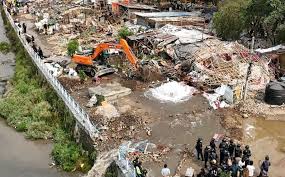
A sweeping government operation to clear and demolish makeshift settlements along the Bagmati River and its tributaries has reached a pivotal stage in Nepal’s capital. The initiative, aimed at preventing monsoon-related disasters, is now raising urgent humanitarian concerns as thousands of residents face displacement.
Evacuation Orders and Security Deployment
Authorities issued a formal notice late last month, giving residents of unauthorized riverbank colonies until the end of April to vacate. Officials warn that these areas—mostly built on public land—are extremely vulnerable to severe flooding during the upcoming rainy season.
To enforce the directive, Nepal Police and the Armed Police Force have been deployed to assist evacuations and maintain order. Special provisions are being made for children, the elderly, and people with disabilities.
Demolitions Expand in Second Phase
After initial clearance in areas like Thapathali, Shantinagar, and Gairigaun, the government has now launched a second phase targeting Balkhu, Banshighat, Shankhamul, and Teku.
Bulldozers and municipal crews are razing temporary and semi-permanent structures. While many residents voluntarily dismantled their homes after receiving notices, an estimated 2,000 people have been displaced in the latest wave alone. Cleared land is now being fenced and monitored to prevent re-encroachment.
Relocation Centers and Support Systems
Displaced families are being taken to temporary holding and registration centers, including Dasharath Stadium, where officials are documenting households. The government’s structured process includes:
Registration and verification of landless families
Digital data collection to guide relocation planning
Temporary shelter arrangements
Only verified landless residents will qualify for rehabilitation aid. Additional services include transport, storage for belongings, health care, and psychosocial counseling.
Human Toll: Tragic Incident and Rising Anxiety
The emotional weight of the eviction drive became tragically evident on May 1, when a 61-year-old displaced man from Balkhu was found dead in the Bagmati River. The incident has amplified concerns over the psychological stress of sudden displacement.
Many affected families—some having lived along the river for decades—now face an uncertain future. While some complied with evacuation orders, others voice frustration over short notice and unclear long-term housing plans.
Government Rationale vs. Public Criticism
Officials defend the campaign as essential for:
Protecting river corridors and public land
Reducing environmental degradation
Minimizing monsoon flood risks
However, rights groups and citizens have raised sharp criticisms. Key concerns include:
Inadequate rehabilitation planning
Legal and ethical issues with forced eviction
Humanitarian fallout on vulnerable populations
Several legal petitions have also been filed, demanding proper identification and guaranteed housing for genuine landless families before any eviction takes place.
What Lies Ahead
The riverbank clearance operation is expected to continue across the Kathmandu Valley until all unauthorized settlements are removed. Authorities describe it as one of the largest urban management and environmental protection drives in recent years.
Conclusion
The Bagmati riverbank evacuation underscores a complex clash between urban planning, environmental protection, and social justice. While the government’s goal of reducing disaster risks and reclaiming public land is clear, the campaign’s lasting success will depend on how effectively displaced communities are rehabilitated.
As the operation advances, balancing enforcement with compassion remains the central challenge—ensuring both safety and dignity for all affected residents.


Log in to comment